Skip to content
Lincoln Foundation Repair

Serving Lincoln and nearby areas

Wall Anchors for Bowing Basement Walls in Lincoln, NE

Stop a basement wall from pushing in, and pull it back where it can go. Free inspection and a written price from a local Lincoln crew.

Book a free foundation inspection

Tell us what you are seeing. A local specialist calls you back the same business day.

Local to Lincoln

We connect property owners in Lincoln and nearby areas, including Near South, Woods Park, Country Club, North Bottoms, Havelock and University Place, with one independent local foundation repair specialist.

  • Heavy, wet clay

    Wymore, the most common Lancaster County soil, has a subsoil of about 42 to 55 percent clay, per USDA. Wet clay is heavy and pushes hard.

  • Frost on the top of the wall

    The City of Lincoln asks for frost-free deck footings at least 36 inches deep. That top 3 feet of soil freezes and swells against the wall.

  • Wet every spring

    USDA data shows common Lincoln clay soils are often saturated within one to three feet of the surface in March and April.

What it costs

Typical published ranges for Lincoln. The contractor's written estimate is the price, and the inspection is free.

WorkTypical range
Inspection and written estimate Free
Wall anchor, installedUsually spaced about every 5 feet $400 to $700per anchor
Carbon fiber or steel straps, typical job $4,000 to $12,000
Bowing wall repair, typical range $4,000 to $15,000
Helical tieback $1,500 to $2,000each

See typical foundation repair prices in Lincoln

Is your wall pushing in?

A basement wall is a retaining wall. It holds back tons of soil all the way around your house. When that soil gets wet, swells, or freezes, it pushes harder. A strong wall holds. A wall that has been pushed for many years can start to bow in.

You will often see it before you feel it. These are the signs Lincoln homeowners call about most:

"There is a long sideways crack running across my block wall."

"The middle of the wall leans into the basement."

"The top row of blocks has slid in past the rest."

"There is a stair-step crack at the corner of the wall."

"A crack in my poured wall is wider at the top."

"Water comes in along the crack every spring."

A wall that is bowing will not fix itself. The good news is that most bowing walls can be braced in place without digging out the whole wall.

Why walls bow in Lincoln

Clay that swells and gets heavy. Most Lincoln homes sit on loess, a fine wind-blown silt, with clay in the lower layers. Wymore, the most common soil in Lancaster County, has a subsoil of about 42 to 55 percent clay, according to USDA. Its shrink-swell rating is in the highest class. When it soaks up water, it swells and pushes sideways on the wall.

Frost on the top of the wall. The City of Lincoln asks for frost-free deck footings at least 36 inches deep. That top three feet of soil freezes every winter. Wet soil swells as it freezes. The push is strongest high on the wall, which is why many Lincoln block walls crack sideways a few blocks down from the top.

Spring water. USDA data shows the main clay soils around Lincoln are often saturated within one to three feet of the surface in March and April. Wet soil weighs more and pushes harder. A yard that slopes toward the house or a downspout that dumps by the wall adds to it.

Block walls. Block walls are built from many pieces held together by mortar. They tend to crack along the joints and bend in the middle. Poured walls are one solid piece. They are stronger, but they can still crack and lean.

Older homes. About 1 in 8 Lincoln homes was built in 1939 or earlier. Older walls often have no steel inside them and have taken decades of pushing.

How a local crew braces a wall

The inspector measures how far the wall has moved and picks the fix that fits. These are the common methods.

Wall anchors

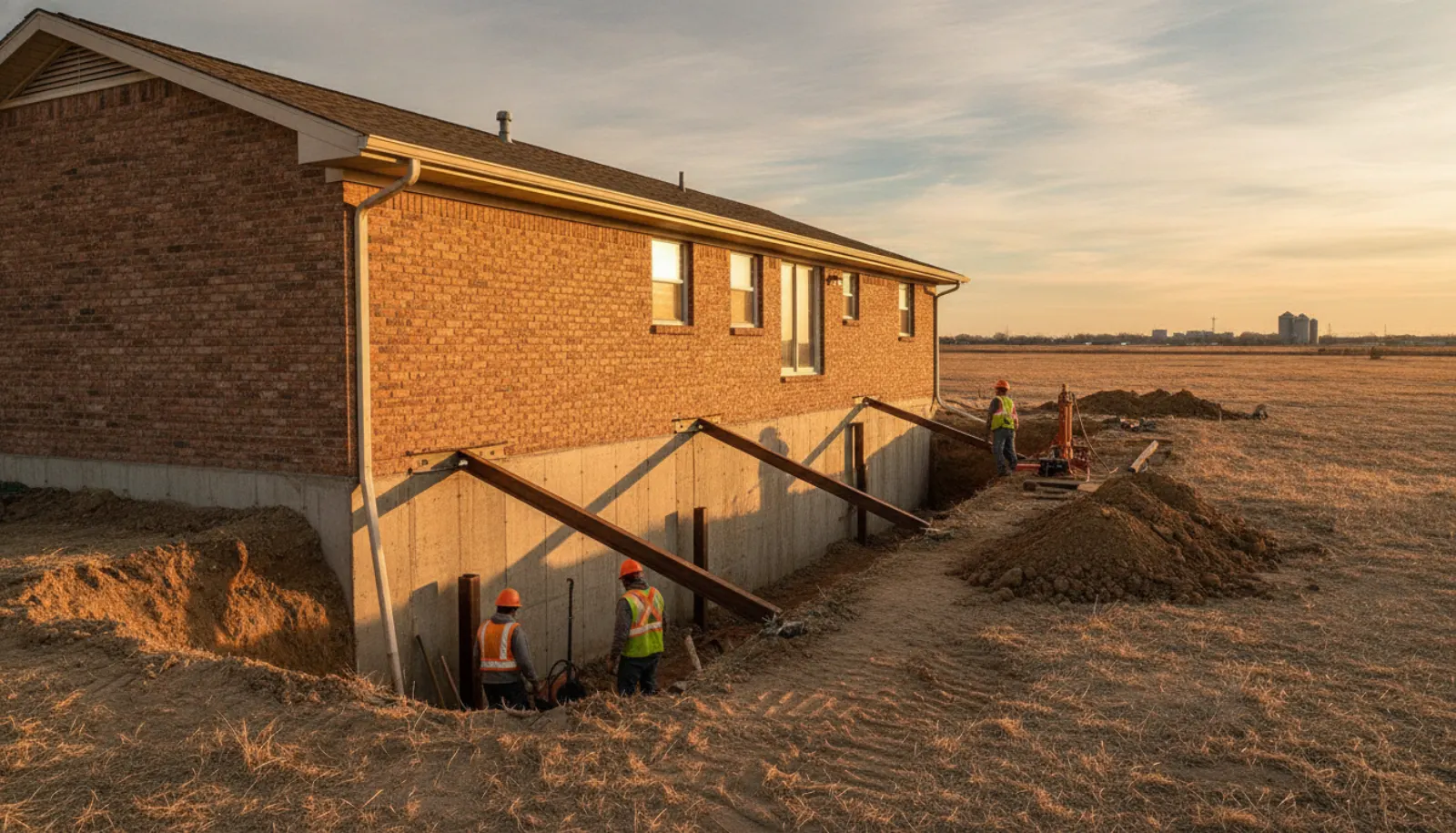
A steel plate goes on the inside of the wall. A steel rod runs from that plate, through the wall, and out into the yard. On the far end is a second plate buried in firm soil, often about 10 feet out. Then the rod is tightened. The soil in the yard holds the wall in place. Over time, the anchors can be tightened more to pull the wall back toward straight. Anchors are usually spaced about every 5 feet along the wall.

Carbon fiber straps

Strong carbon fiber strips are glued to the inside of the wall from top to bottom. They hold the wall where it is. They are thin, can be painted, and need no digging outside. They work best on walls that have not moved far.

Steel beams

Steel beams stand up against the inside of the wall, bolted to the floor and to the joists above. They hold the wall and work when there is no room for anchors outside, like when a driveway or the neighbor's house is too close.

Helical tiebacks

These are long steel shafts screwed into the soil from inside the basement, through the wall, at an angle. They work like wall anchors but need less digging outside. They suit tight lots.

Rebuilding the wall

If a wall has moved too far, bracing is no longer safe. The crew digs out the outside, takes down the bad part of the wall, and builds it again. This costs the most, which is why bracing early is worth it.

Fix the water too

Bracing holds the wall. Taking water out of the soil takes pressure off it. Many bowing wall jobs also include an interior drain and sump pump, downspout extensions, or regrading the yard. See basement waterproofing.

What a good inspection covers

Expect the inspector to:

  • Measure how far the wall bows, at several points
  • Check whether the top or bottom of the wall has slid
  • Look at the cracks, and whether any are leaking
  • Check outside for room to place anchors, and for grading, gutters and downspouts
  • Explain which bracing fits your wall and why
  • Give you a written plan with the number and spacing of anchors or straps

What moves the price

Wall anchors run about $400 to $700 each, installed, according to Angi. Carbon fiber or steel strap jobs run about $4,000 to $12,000, and most bowing wall repairs fall between about $4,000 and $15,000, according to Fixr and This Old House. These things move the price most:

How long the wall is

A longer wall needs more anchors or straps.

How far it has moved

A wall that needs to be pulled back costs more than one that only needs holding.

How many walls

Two or three walls cost more than one.

The yard

Decks, patios and driveways can rule out anchors and push you toward beams or tiebacks.

Water work

Adding a drain and pump raises the price.

See the full cost guide for more.

Frequently asked questions

How do I know if my basement wall is bowing?

Look for a long sideways crack across a block wall, often a few blocks down from the top. Hold a long level or a tight string against the wall. If the middle sits closer to you than the top and bottom, the wall is bowing in.

Can a bowing wall be pulled back straight?

Often part of the way. Wall anchors can be tightened a little at a time, often over a few seasons, to bring the wall back. How far it goes depends on the wall and the soil. The main goal is to stop it moving.

Wall anchors or carbon fiber straps?

Straps are glued to the inside of the wall and hold it where it is. They work well for walls that have not moved far. Wall anchors reach out into the yard and can be tightened to pull the wall back. Steel beams are another option when the yard has no room for anchors.

Will wall anchors tear up my yard?

A little. The crew digs a small hole in the yard for each anchor plate, then fills it back in. Most yards look normal again after the grass grows back.

How fast does a bowing wall get worse?

Some walls move a little each year. Others jump after a wet spring or a hard winter. Once a wall bows past a certain point, bracing is no longer enough and the wall has to be rebuilt. That costs a lot more, so it pays to act early.

Do I need to fix the water too?

Often, yes. Water in the soil makes it heavier and makes frost push harder. A drain, a sump pump, downspout extensions or regrading takes some pressure off the wall.

Do wall anchors need upkeep?

Anchors are often checked and tightened over time, mostly in the first few years. Ask what the contractor includes and whether the warranty covers it.

Questions to ask before you sign

  1. How far has my wall moved, and is it still safe to brace?
  2. Anchors, straps, beams or tiebacks, and why that one?
  3. How many, and how far apart?
  4. Will you try to pull the wall back, or only hold it?
  5. Who tightens the anchors later, and is that included?
  6. What does the warranty cover, and does it transfer if I sell?
(402) 923-8559 Free inspection