Skip to content
Lincoln Foundation Repair

Serving Lincoln and nearby areas

Basement Waterproofing in Lincoln, NE

Stop the water in your basement for good. A local Lincoln crew finds where it gets in and gives you a written price, for free.

Book a free foundation inspection

Tell us what you are seeing. A local specialist calls you back the same business day.

Local to Lincoln

We connect property owners in Lincoln and nearby areas, including Near South, Woods Park, Country Club, North Bottoms, Havelock and University Place, with one independent local foundation repair specialist.

  • Soaked soil in spring

    USDA data shows the main Lincoln clay soils are often saturated within one to three feet of the surface in March and April.

  • May and June storms

    May is Lincoln's wettest month, with a normal of about 4.9 inches. June is close behind at about 4.5.

  • Eleven flood sources

    The City of Lincoln lists 11 creeks and streams that can flood, from Salt Creek to Deadman's Run.

What it costs

Typical published ranges for Lincoln. The contractor's written estimate is the price, and the inspection is free.

WorkTypical range
Inspection and written estimate Free
Waterproofing, whole job $3,000 to $10,000
Interior drain $40 to $120per linear foot
Sump pump, installed $600 to $2,500
Seal a leaking crack $250 to $1,000per crack
Regrade the yard $500 to $3,000

See typical foundation repair prices in Lincoln

What the local crew fixes

You do not need to know where the water comes from. Tell us what you see. These are the calls we hear most from Lincoln homeowners:

"There is water on the floor every time it rains hard."

"The basement leaks every spring."

"Water comes in along the bottom of the walls."

"A crack in the wall drips."

"The window well fills up with water."

"The basement smells musty, and the walls feel damp."

"There is a white chalky crust on the concrete."

"My sump pump runs all the time," or "I do not have a sump pump at all."

Why Lincoln basements get wet

Clay holds water against the wall. The soil around most Lincoln homes is loess over clay. Wymore, the most common soil in Lancaster County, has a subsoil that is about 42 to 55 percent clay, according to USDA. Clay soaks up water but lets it drain out very slowly. So after a storm, water sits in the soil right next to your basement wall.

Spring saturation. USDA data shows the main clay soils here are often saturated within one to three feet of the surface in March and April. When the ground is that wet, water pushes on the basement wall from the outside. It comes in at cracks, at tie holes in poured walls, at mortar joints in block walls, and at the joint where the wall meets the floor.

Storm season. Lincoln gets about 29 inches of rain in a normal year, according to University of Nebraska climate records. May is the wettest month at about 4.9 inches, and June is close behind at about 4.5. Some months are far wetter. June 1967 brought almost 13 inches.

Creeks and low ground. The City of Lincoln lists 11 creeks and streams that can flood, including Salt Creek, Antelope Creek, Beal Slough and Deadman's Run. In May 2015, the city asked people in the North and South Bottoms to think about leaving their homes as water rose near the Salt Creek levee. Homes in low spots near a creek can see more water in the soil after big rains.

Clay that moves. The same clay swells when wet and shrinks when dry. It can open small cracks in a wall, and then the next storm uses them.

Older walls. About 1 in 8 Lincoln homes was built in 1939 or earlier. Many were built before drains around the footing and damp proofing on the wall were common.
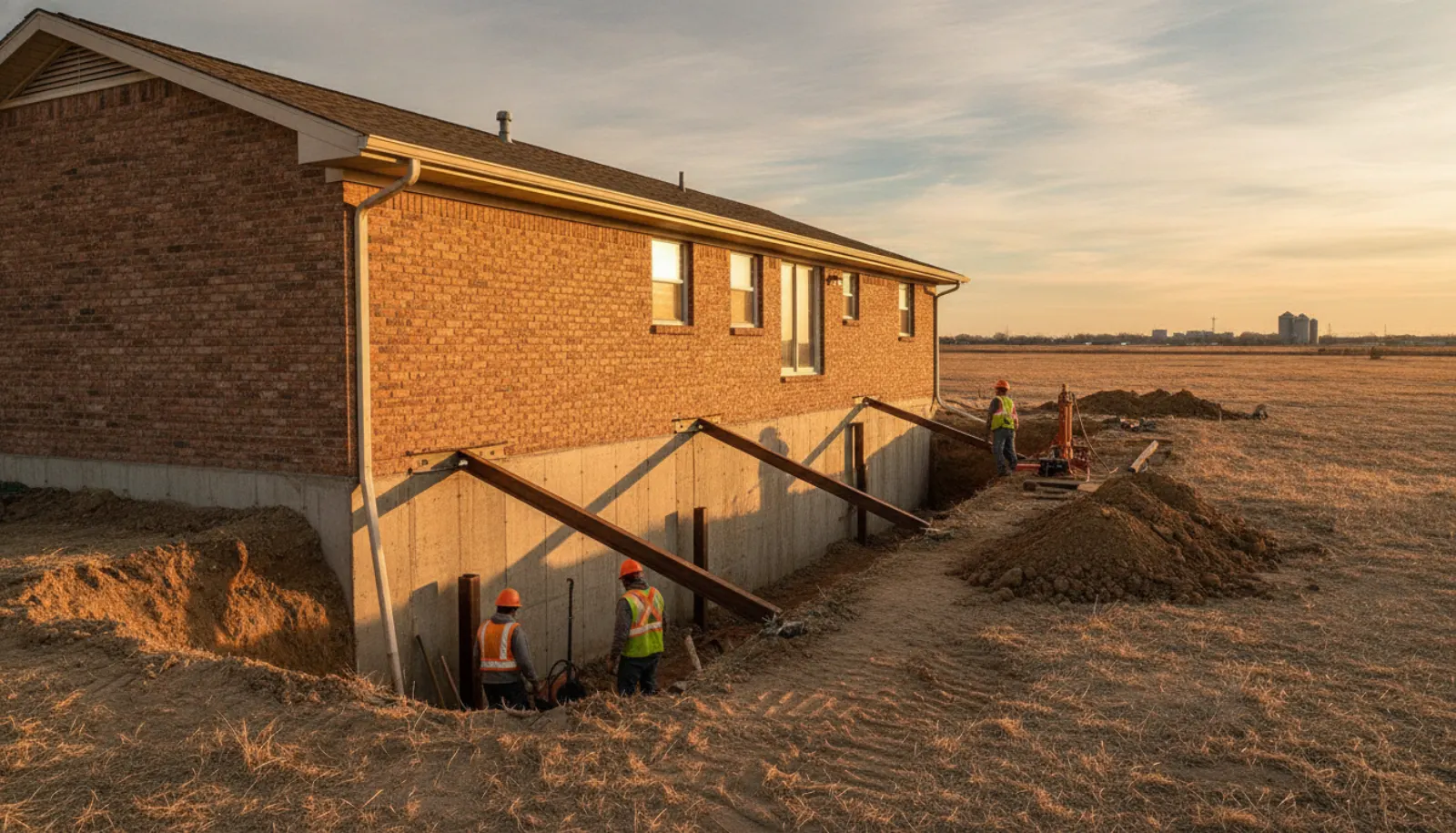
How a local crew keeps water out

The inspector picks the fix based on where the water gets in and how much there is.

Fix the outside first

The cheapest fixes come first. Gutters that overflow, downspouts that dump next to the house, and a yard that slopes toward the wall send a lot of water where you do not want it. Downspout extensions and regrading can make a big difference on their own.

Seal the cracks

A single leaking crack in a poured wall can often be sealed from the inside. The crew fills the crack with a foam or epoxy that goes all the way through the wall. See foundation crack repair.

Interior drain and sump pump

This is the most common whole-basement fix. The crew cuts a narrow strip of the floor along the walls, lays a drain pipe in gravel, and runs it to a sump pit. A sump pump pushes the water out and away from the house. A plastic sheet on the wall guides any water that comes through the wall down into the drain. Then the floor is patched with new concrete.

Battery backup

Big storms can knock out power right when the pump is needed most. A battery backup pump keeps going when the power is out. For homes near a creek or in low ground, it is often worth asking about.

Outside waterproofing

For some homes, the crew digs down to the footing, seals the outside of the wall, and lays a drain at the bottom. It costs more and tears up the yard for a while. It can make sense for finished basements or when the wall needs other work.

Window wells

A window well with no drain or cover can fill like a bucket. A cover, a drain at the bottom, or both can stop that leak.

What a good inspection covers

Expect the inspector to:

  • Walk every wall and look for stains, white crust, drips and cracks
  • Check the joint where the wall meets the floor
  • Check the sump pump, if you have one, and test that it runs
  • Look at gutters, downspouts, window wells and how the yard slopes
  • Ask when it leaks: every rain, only big storms, or only in spring
  • Tell you plainly if a small outside fix might be enough

What moves the price

Most basement waterproofing jobs fall between about $3,000 and $10,000, with a national average near $5,000, according to Fixr. These things move the price most:

How many feet of drain

Interior drains run about $40 to $120 per linear foot.

Inside or outside

Outside work costs more because of the digging.

The pump

A sump pump runs about $600 to $2,500 installed. A battery backup adds to that.

What is in the way

Finished walls, shelves and furnaces near the wall add time.

The wall itself

A wall that is also bowing in needs bracing too.

See the full cost guide for more detail.

Frequently asked questions

Why does my basement only leak in spring?

Spring is when Lincoln soil is wettest. USDA data shows the main clay soils here are often soaked to within one to three feet of the surface in March and April. That water presses on the wall and finds the weak spots. A crack that is dry in August can run in April.

Do I need a sump pump?

If water comes up through the floor or along the bottom of the walls, a drain and sump pump is the most common fix. If water only comes in at one crack or one window well, a smaller fix may do. The inspector will tell you which.

Inside or outside waterproofing, which is better?

Inside drains are the most common choice. They cost less and do not mean digging up the yard. Outside work means digging down to the footing and sealing the wall. It costs more but can make sense for a finished basement or when other work needs the wall open.

Will sealer paint fix my wet basement?

Waterproof paint can help with light dampness on a wall. It will not stop water pushed in by soaked soil. If you see puddles, drips or water at the floor joint, you need to deal with the water outside the wall.

Does homeowners insurance pay for a wet basement?

Usually not for slow seepage. The Nebraska Department of Insurance says homeowners policies usually do not cover flood damage, and the City of Lincoln says the same. Sudden events like a burst pipe are more often covered. Read your policy or ask your agent.

What should I do if my basement floods?

Stay safe and shut off power to the basement if you can do it without stepping in water. The City of Lincoln advises pumping a flooded basement out slowly, about one third of the water per day, to avoid damage to the walls.

How long does basement waterproofing take?

Crack sealing is often a few hours. An interior drain and sump pump for a typical basement takes about one to three days. Outside work takes longer because of the digging.

Will it smell better after?

Usually, yes. Stopping the water is the first step. A dehumidifier helps keep the air dry after that. The inspector can check for mold and tell you if it needs more work.

Questions to ask before you sign

  1. Where exactly is the water getting in, and how do you know?
  2. Is there a cheaper outside fix I should try first?
  3. How many feet of drain, and where does the water go after the pump?
  4. Is a battery backup pump included or extra?
  5. What does the warranty cover, and for how long?
  6. Does the price include patching the floor and cleanup?
(402) 923-8559 Free inspection