Skip to content
Lincoln Foundation Repair

Serving Lincoln and nearby areas

Cracks in Brick in Lincoln, NE

A crack in your brick can be worn mortar or a sign the foundation below has moved, so get a free inspection to find out which, and a written price for the fix.

Book a free foundation inspection

Tell us what you are seeing. A local specialist calls you back the same business day.

Local to Lincoln

We connect property owners in Lincoln and nearby areas, including Near South, Woods Park, Country Club, North Bottoms, Havelock and University Place, with one independent local foundation repair specialist.

What it costs

Typical published ranges for Lincoln. The contractor's written estimate is the price, and the inspection is free.

WorkTypical range
Inspection and written estimate Free
Tuckpointing, walls 8 feet or lower $5 to $10per square foot
Tuckpointing a wall, typical job $400 to $2,500
Brick wall crack repair $20 to $60per square foot
Pier to lift a sinking corner $1,000 to $3,000per pier

See typical foundation repair prices in Lincoln

What brick cracks look like

Brick shows movement in a few common shapes. Where the crack is, and how it is shaped, tells you a lot.

Stair-step cracks

That follow the mortar joints up and over at an angle, like a staircase.

Vertical cracks

That run straight up through the bricks, often near a corner.

Cracks at window and door corners

Running up or out at an angle.

A crack wider at the top than the bottom

Or the other way around.

Brick pulling away

From window trim, door frames or siding.

Broken or popped bricks

With the face flaking off.

Loose, sandy mortar

You can scratch out with a key.

A chimney that leans

Or has a gap where it meets the house.

Mortar wear or foundation movement?

Brick and mortar wear out on their own. Mortar is the soft part on purpose, so it takes the stress and gets replaced over time. Not every crack means the ground moved.

Signs it is mostly the mortar:

  • Thin cracks spread over a large area, not in one spot.
  • Mortar that is soft, sandy or missing in many joints.
  • Bricks that are flaking on the face where water sits.
  • No sticking doors, sloping floors or wall cracks inside.

Signs the foundation moved:

  • One stair-step crack centered on a corner of the house.
  • A crack wider at one end, or bricks that no longer line up across it.
  • Cracks that grow from one season to the next.
  • Matching cracks inside the house near the same corner, or doors there that stick.
  • Gaps between the brick and window or door frames.
  • A basement wall below with a crack in the same area.

Why brick cracks in Lincoln

Clay that moves under the footing. Most Lincoln homes sit on loess with clay below. USDA rates the clay subsoil of Wymore, the most common soil in Lancaster County, in the highest shrink-swell class. When the soil under one corner dries and shrinks more than the rest, that corner drops. Brick is stiff and cannot bend, so it cracks along the mortar.

Wet years and dry years. Lincoln averages about 29 inches of rain a year. In the 2012 drought it got about 19. After a dry summer, the clay shrinks back from the footing, and corners settle. When the wet season comes back, it swells again. A crack that opens and closes with the seasons is common here.

Freeze and thaw. The City of Lincoln asks for frost-free deck footings at least 36 inches deep. Water that soaks into brick and mortar freezes, grows, and breaks the face off the brick bit by bit. Mortar under leaky gutters and downspouts wears out first.

Older homes. About 1 in 8 Lincoln homes was built in 1939 or earlier. Older brick and stone have been through many decades of freeze and thaw. Older soft mortar also needs a matching soft mortar when it is repaired. Hard modern mortar can crack old brick.

When to worry

Watch and measure a thin crack that stays the same. Call for an inspection soon if:

  • the crack is wider than about a quarter inch,
  • the bricks on one side stick out past the other,
  • the crack grew since last season,
  • brick is pulling away from windows, doors or the wall behind it,
  • the chimney leans, or
  • you have cracks inside or sticking doors on the same corner.

How brick cracks are usually fixed

The order matters. Fix what is moving first, then fix the brick.

  1. Find the cause. The inspector checks floor levels inside, the basement or crawl space below, and the drainage at that corner.
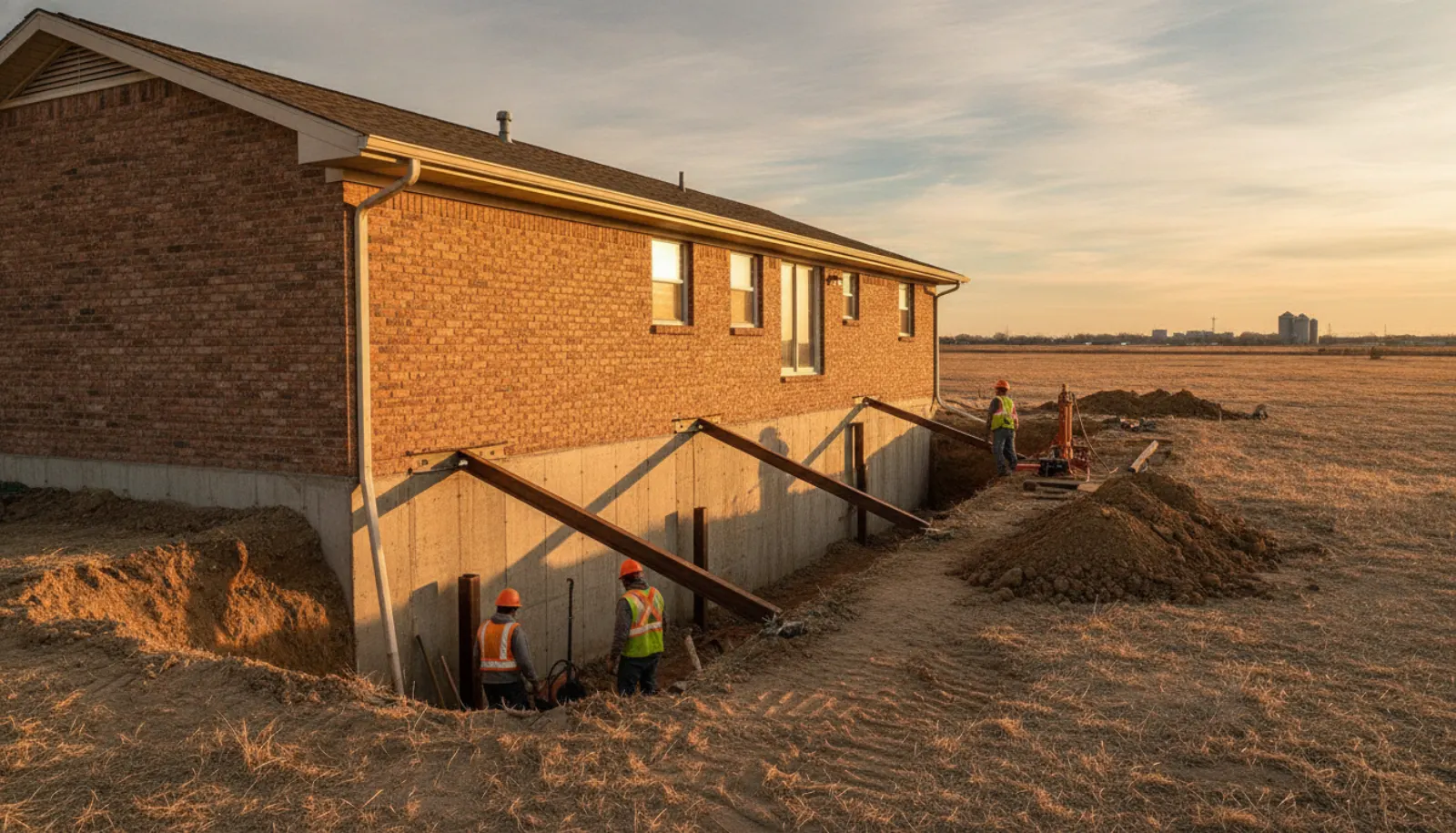
  2. Stop the movement. If a corner has sunk, steel piers are placed under the footing to lift and hold it. If water is soaking one side, downspouts and grading come first.
  3. Repoint the mortar. Old mortar is ground out and new mortar packed in. This is called tuckpointing.
  4. Replace broken brick. Cracked or flaking bricks are cut out and swapped with a close match.
  5. Fix lintels. Rusted steel over windows is cleaned and painted or replaced.

The table on this page shows typical ranges from national cost guides for masonry and pier work. Brick repair alone is often a few hundred to a few thousand dollars. Pier work under a sinking corner costs more. The inspection and written estimate are free.

What to do before the inspection

  1. Photograph each crack with a coin or ruler for scale.
  2. Mark the ends with chalk or a pencil and the date.
  3. Check inside the same corner for cracks over doors and windows and doors that stick.
  4. Check the downspout nearest the crack. Make sure it drains well away from the house.
  5. Do not caulk or patch yet. A fresh patch hides how the crack has moved, and that is what the inspector needs to see.

Frequently asked questions

Are stair-step cracks in brick serious?

They can be. A thin stair-step crack in old mortar may just be wear. A stair-step crack that is wider at one end, keeps growing, or lines up with sticking doors inside often means the foundation under that corner has moved.

Can I just fill the cracks with mortar?

If the crack is old and not moving, repointing the mortar fixes it. If the foundation is still moving, new mortar cracks again in the same place, often within a year or two. Find out why it cracked first.

Why is my brick cracking above a window?

Brick over a window or door sits on a steel angle called a lintel. If the steel rusts, it swells and lifts the brick, making cracks at the corners. If the wall below settles, the opening squeezes and cracks too. The inspector can tell which.

My brick is pulling away from the house. What does that mean?

On many houses, the brick is a single outer layer tied to the wood wall behind it. A gap between the brick and the window trim or siding often means the brick or the footing under it has dropped or leaned. That one should be checked soon.

Do cracks in a brick chimney mean foundation trouble?

Sometimes. A chimney sits on its own footing and is very heavy, so it can settle on its own. A chimney that leans or pulls away from the house needs a look soon, both for the foundation and for safety.

(402) 923-8559 Free inspection