Skip to content
Lincoln Foundation Repair

Serving Lincoln and nearby areas

House Settling in Lincoln, NE

Some settling is normal, but a corner that keeps sinking means the soil under the footing is giving way, so get a free inspection to tell which you have and a written price to fix it.

Book a free foundation inspection

Tell us what you are seeing. A local specialist calls you back the same business day.

Local to Lincoln

We connect property owners in Lincoln and nearby areas, including Near South, Woods Park, Country Club, North Bottoms, Havelock and University Place, with one independent local foundation repair specialist.

What it costs

Typical published ranges for Lincoln. The contractor's written estimate is the price, and the inspection is free.

WorkTypical range
Inspection and written estimate Free
Pier to lift a sinking corner $1,000 to $3,000per pier
Underpinning a house with piers, whole job $10,000 to $40,000
Foundation repair in Lincoln, minor jobs $2,000 to $3,900
Regrade the yard $500 to $3,000

See typical foundation repair prices in Lincoln

What settling looks like

Settling shows up both inside and outside. It usually centers on one part of the house.

Stair-step cracks

In brick or block near one corner.

Cracks over doors and windows

Running up at an angle.

A floor that slopes

Toward one outside wall.

Doors that stick

Or will not latch on one side of the house.

A gap

Between the house and the porch, garage or an addition.

Cracks in the basement wall

That are wider at the top or bottom.

Gaps where walls meet the ceiling

Or trim pulling away.

Caulk joints

Around windows that keep tearing open.

Normal settling vs a sinking foundation

Normal settling happens early and then stops. It leaves thin cracks in drywall, small cracks in the basement floor, and maybe a hairline crack in a poured wall. The cracks do not grow, and the doors still work.

A sinking foundation keeps going. One part of the house drops more than the rest. Cracks grow, open wider at one end, or get new cracks next to them. Doors near that corner get worse each year.

The key is change over time. A crack you have watched for five years that has not moved is a very different problem from a crack that showed up last summer and is already wider.

Why houses settle in Lincoln

Clay that shrinks in dry weather. Most Lincoln homes sit on loess, a fine wind-blown silt, with clay below. USDA rates the clay subsoil of Wymore, the most common soil in Lancaster County, in the highest shrink-swell class. Crete, another common soil here, is also clay-rich below the topsoil. When clay dries, it shrinks and pulls away from the footing. That lets the house drop a little.

Dry years after wet ones. Lincoln averages about 29 inches of rain a year, but in the 2012 drought it got only about 19. Long dry stretches shrink the soil deeper than usual. Corners near large trees, south and west walls that get the most sun, and areas under eaves without gutters often dry out first. Those corners settle first.

Soaked soil in spring. The same soil is often saturated within one to three feet of the surface in March and April, according to USDA data. Soft, wet clay under a footing can squeeze out and let it sink, especially where a downspout or a low spot keeps one corner wet.

Frost. The City of Lincoln asks for frost-free footings at least 36 inches deep for decks. Older porches, steps and add-ons built on shallow footings can heave in winter and drop in spring.

Housing age. About 1 in 8 Lincoln homes was built in 1939 or earlier, and the median home was built around 1982. Older homes have seen many cycles of wet and dry. Newer homes in growing areas sit on fill that is still packing down.
When to call

Watch thin cracks that do not change. Call for an inspection soon if:

  • a crack is wider than about a quarter inch or wider at one end,
  • a crack grew since you last checked,
  • doors on one side are getting harder to close,
  • the floor slopes more than it did,
  • a porch, garage or addition is pulling away from the house, or
  • you are buying or selling and want a written answer.

How settling is usually fixed

Steel piers

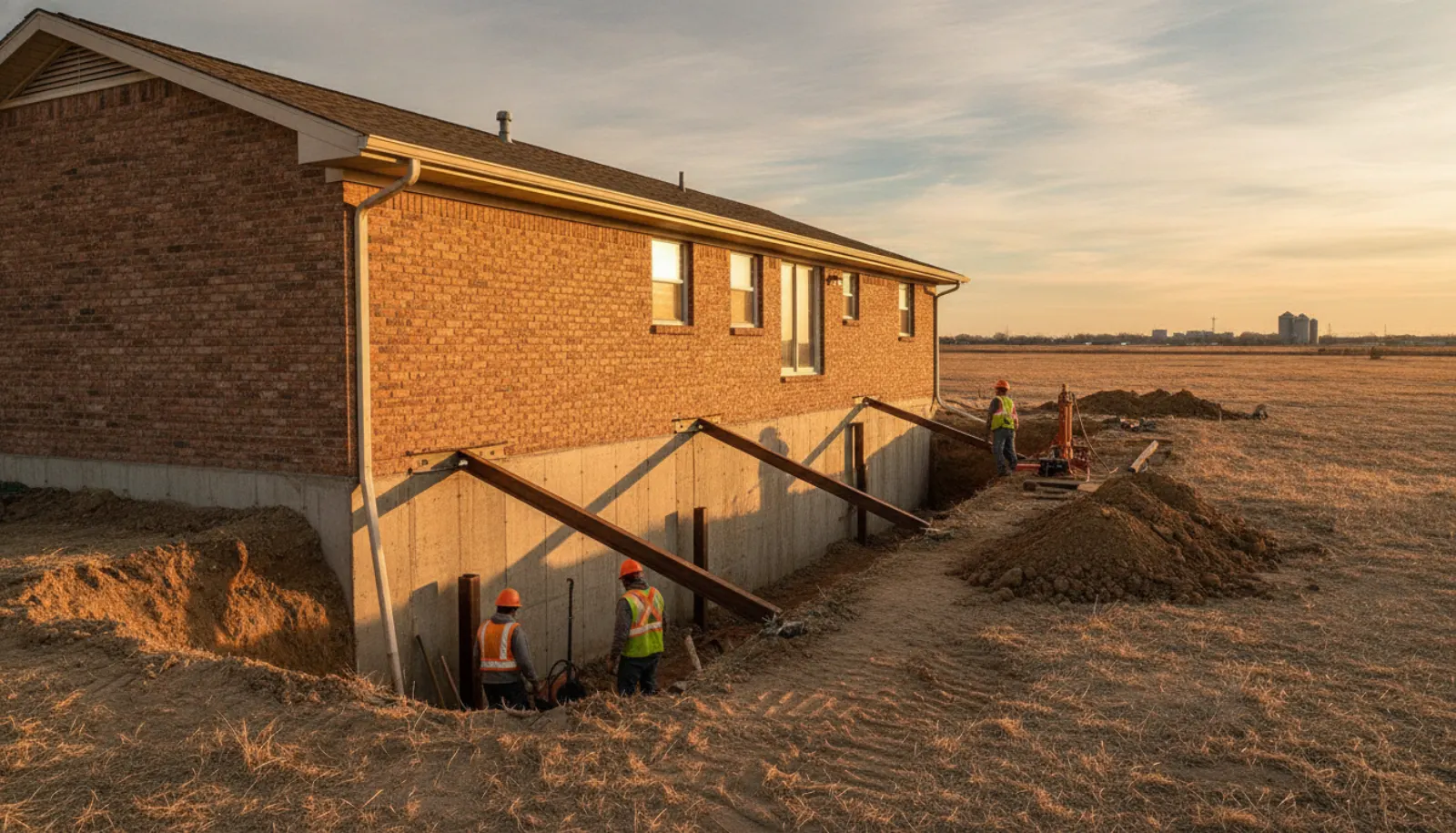
Push piers or helical piers go down past the soft, moving clay to firmer ground. The footing is set on them and lifted back as far as is safe.

Water control

Gutters, longer downspouts and soil that slopes away from the house keep moisture under the footing more even.

Crack and finish repair

After the house is stable, cracks in brick, block and drywall are sealed and patched.

Monitoring

If the settling looks old and stable, the inspector may suggest marking cracks and checking again in a season before spending money.

The table on this page shows typical ranges from national and local cost guides. The number of piers depends on how much of the house has dropped. The inspection and written estimate are free.

What to do before the inspection

  1. Mark and date every crack inside and out. Take photos with a ruler for scale.
  2. Note the timing. Did it start after a dry summer, a wet spring, new landscaping or a plumbing leak?
  3. Check drainage at the low corner. Make sure gutters are clear and downspouts run well away.
  4. Water evenly in a drought. A soaker hose a foot or two from the foundation keeps soil from shrinking too far. Do not flood it.
  5. Gather paperwork. Past inspection reports, repair receipts and warranties help the inspector see what has changed.

Frequently asked questions

Is it normal for a new house to settle?

A little, yes. Soil under and around a new house packs down for the first few years. Thin drywall cracks and small shrinkage cracks in concrete are common. Cracks that keep growing, or one corner that keeps dropping, are not normal settling.

How do I know if my house is still settling?

Mark the ends of cracks with a pencil and the date, and check them every few months. Note which doors stick. If the cracks grow or more doors stick over a year, the house is still moving.

Why did my house start settling after so many years?

Something changed under it. A drought dried and shrank the clay, a new downspout or patio sent water to one corner, a tree's roots pulled water from the soil, or a plumbing leak washed soil away. The inspector looks for what changed.

Does a settled house need to be lifted?

Not always. If the settling stopped long ago and nothing is getting worse, cosmetic repair may be all it needs. If a corner is still sinking, piers are the usual fix to stop it and lift it back as far as is safe.

Can trees near my house cause settling?

They can. Large trees pull a lot of water from clay soil in summer, and the soil shrinks. In a dry year, a corner near a big tree can drop. Keep beds watered evenly during long dry spells and ask the inspector about trees near the walls.

(402) 923-8559 Free inspection